
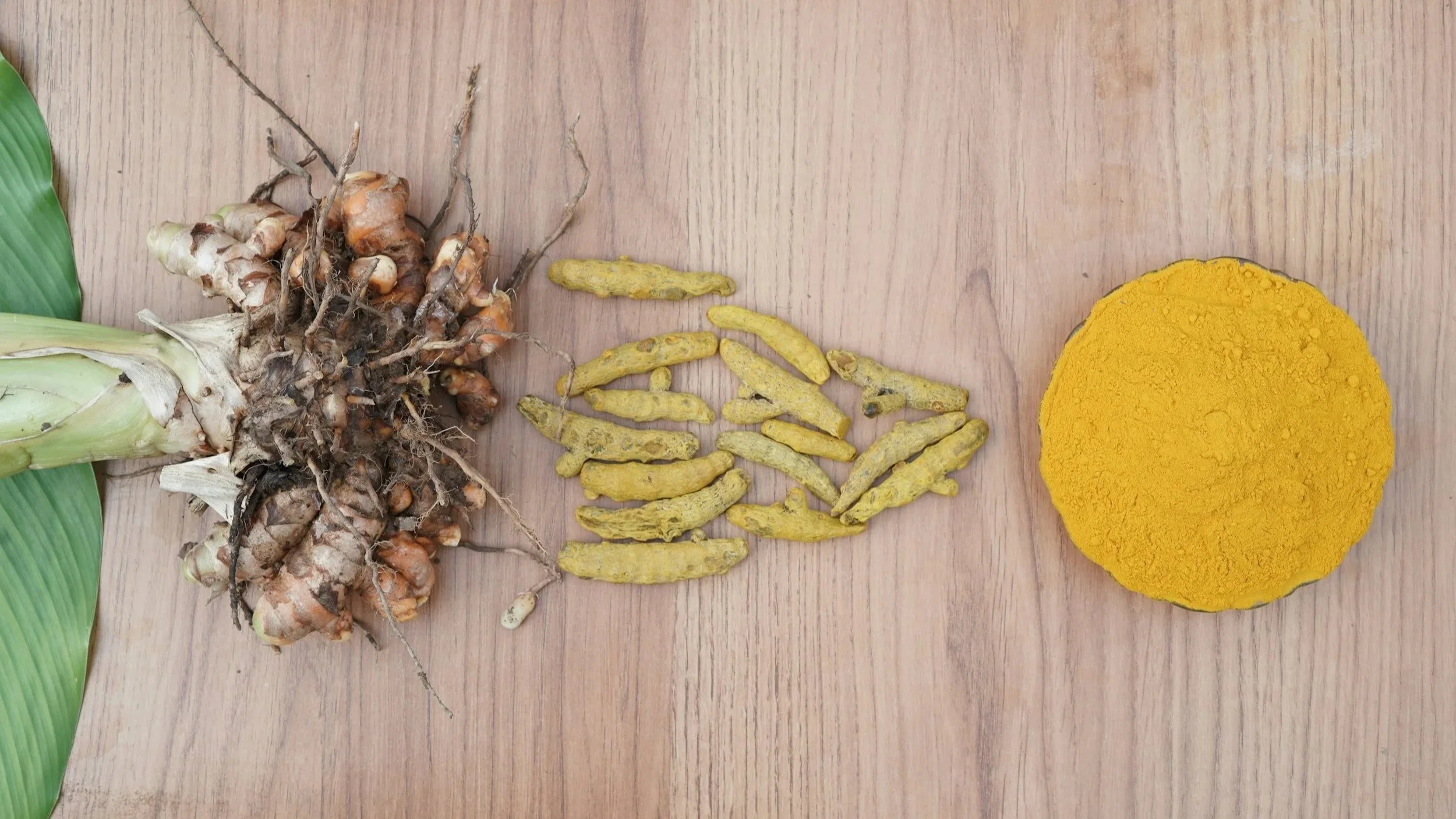
If you've ever cooked with turmeric, you'll recognise its beautiful golden-yellow colour. It's a familiar ingredient in many kitchen cupboards, often used to add colour, flavour and warmth to everyday meals.
But turmeric has a much longer history than simply being a popular cooking spice.
Known botanically as Curcuma longa, turmeric is the underground stem (rhizome) of a plant belonging to the ginger family. It has been used for thousands of years in traditional Indian cooking and Ayurvedic practices, where it is valued for its distinctive qualities and versatility.
In Ayurveda, turmeric is known as Haridra. It is an interesting example of how everyday ingredients can have a place in both traditional food culture and a wider approach to wellbeing.
So, what makes this golden spice so special?
Turmeric and Ayurveda
In Ayurveda, food is about more than simply providing nourishment. The qualities of what we eat, how we prepare it and how well we digest it are all considered important.
Herbs and spices play an important role in Ayurvedic cooking. They are traditionally used to add flavour, variety and qualities that complement different foods and individual needs.
Turmeric is particularly interesting because of its combination of tastes and qualities.
In traditional Ayurvedic classification, turmeric has the following properties:
Rasa (taste): Tikta (bitter) and Katu (pungent).
Guna (qualities): Ruksha (dry).
Virya (potency): Ushna (heating).
Vipaka (post-digestive effect): Katu (pungent).
These properties are traditionally associated with balancing Kapha and Pitta, although individual suitability and the quantity used are important considerations.
What does this mean in everyday terms?
Its bitter and pungent tastes, together with its warming and drying qualities, give turmeric an interesting place in traditional Ayurvedic cooking.
However, Ayurveda doesn't suggest that one ingredient is right for everyone. Its heating and drying qualities may not suit every individual, particularly when used in larger quantities.
This is one of the important principles of Ayurveda: considering the individual rather than simply following a list of foods labelled as healthy.
What does modern research tell us about turmeric?
Turmeric has attracted considerable scientific interest, particularly because of its naturally occurring compounds called curcuminoids.
The best-known of these is curcumin, which contributes to turmeric's distinctive golden colour.
Curcumin has been investigated for its antioxidant and anti-inflammatory properties. However, it's important to understand the difference between traditional use, laboratory research and evidence from human studies.
Here are some of the areas researchers have been exploring.
Antioxidant properties
Turmeric contains compounds that demonstrate antioxidant activity. Antioxidants help protect cells against oxidative stress, which occurs when there is an imbalance between free radicals and the body's ability to manage them.
Inflammation
Curcumin has been studied for its potential anti-inflammatory effects. Some human studies have explored its use in people experiencing joint discomfort, particularly osteoarthritis.
Early findings are promising, but further high-quality research is needed before firm conclusions can be reached.
Digestive health
Turmeric has a long history of traditional use in Ayurvedic preparations associated with digestion.
Modern research has explored curcumin in relation to digestive conditions, but there isn't sufficient evidence to claim that ordinary culinary turmeric treats digestive disorders.
Skin health
Turmeric has traditionally been used in various skin preparations. Its antioxidant and anti-inflammatory properties have also attracted research interest, although it isn't an established treatment for skin conditions.
Turmeric or curcumin: is there a difference?
You may notice that scientific studies often refer to curcumin rather than turmeric.
There is an important distinction:
Turmeric is the whole rhizome, which can be used fresh or dried and ground into a powder.
Curcumin is one of the naturally occurring compounds found within turmeric.
Curcuminoids are a group of compounds that includes curcumin.
Much of the scientific research uses concentrated curcumin extracts or specially formulated supplements rather than the quantities of turmeric normally used in cooking.
This means that research findings about concentrated supplements cannot automatically be applied to someone adding half a teaspoon of turmeric to their dinner.
Turmeric is an interesting ingredient, but it isn't a miracle food or a replacement for a balanced diet and appropriate healthcare.
Bringing turmeric into your everyday cooking
One of the simplest ways to enjoy turmeric is to include it in your cooking.
You don't need complicated recipes or expensive supplements. A little turmeric can add warmth, colour and flavour to meals you already enjoy.
Here are some easy ways to use it:
Add a little to homemade vegetable soups and stews.
Include it in lentil dishes and vegetable curries.
Combine it with ginger and cinnamon in warming drinks.
Stir it into rice or homemade vegetable stock.
Add it to roasted vegetables with a little olive oil.
Combine it with cumin and coriander when cooking pulses.
Turmeric is often used alongside other spices, including ginger, cumin, coriander and black pepper. These combinations create depth of flavour and make it easy to bring more variety into everyday meals.
What about black pepper?
You may have heard that turmeric should always be combined with black pepper.
Black pepper contains a naturally occurring compound called piperine, which has been studied for its ability to increase the absorption of curcumin.
However, much of this research relates to concentrated curcumin preparations rather than ordinary amounts of turmeric used in cooking.
Black pepper is a lovely addition to savoury dishes and can be included in Golden Milk if you enjoy the flavour, but it isn't essential every time you use turmeric.
It's also worth remembering that products designed to increase curcumin absorption can have different safety considerations from ordinary culinary turmeric.
Recipe: Ayurvedic-inspired Golden Milk
Golden Milk is a warming drink made with milk, turmeric and complementary spices. Sometimes known as Haldi Doodh, it has a place in traditional Indian household food culture.
It's a lovely drink to enjoy during the cooler months, particularly as part of an evening routine when you're looking for something warm and comforting.
This is my simple version, using ingredients that are easy to find.
Ingredients – serves 1
250ml milk of your choice (dairy, almond or coconut milk)
½ teaspoon ground turmeric
¼ teaspoon ground cinnamon
A small pinch of ground ginger
A pinch of black pepper (optional)
1 teaspoon coconut oil (optional)
A little honey or maple syrup to taste
A dash of vanilla (optional)
Method
Pour the milk into a small saucepan.
Add the turmeric, cinnamon, ginger and black pepper if using.
Stir well and warm gently over a low heat. Avoid boiling.
Add the coconut oil if using and stir until combined.
Remove from the heat and allow to cool slightly.
Add honey or maple syrup to taste.
Pour into your favourite mug and enjoy warm.
A little tip: Adjust the spices to suit your taste. You can leave out the black pepper and coconut oil if you prefer. If using dairy milk or a plant-based alternative, choose whichever you enjoy and digest comfortably.
A little word about using turmeric safely
Turmeric has a long history of use as a culinary spice, and ordinary quantities used in everyday cooking are generally considered safe for most people.
However, using turmeric in food is different from taking concentrated turmeric or curcumin supplements.
High-dose supplements and products formulated to increase absorption have been associated with rare cases of liver injury. Turmeric supplements may also interact with medicines.
The UK's Committee on Toxicity has specifically reviewed the potential risks associated with turmeric and curcumin supplements.
If you take prescribed medication, have an existing health condition, particularly involving your liver, gallbladder or bile ducts, or are pregnant or breastfeeding, speak to your GP or pharmacist before considering turmeric supplements or using turmeric in medicinal quantities.
There is no need to take concentrated turmeric supplements simply because turmeric is considered a valuable traditional spice.
Bringing a little more Ayurveda into everyday life
One of the things I particularly like about Ayurveda is its emphasis on everyday habits.
Wellbeing doesn't always need to involve big changes, complicated routines or expensive products. Sometimes it starts with paying a little more attention to what we eat, how we prepare our meals, our daily routines and the way we respond to the changing seasons.
Turmeric is a lovely example of how traditional food knowledge can become part of modern everyday living.
Rather than searching for one particular ingredient that promises to improve everything, Ayurveda encourages us to look at the bigger picture.
How do we feel after eating? Are our meals varied and satisfying? Do our daily routines support us? Are we making choices that suit our individual needs?
You don't need to transform your diet overnight. Start with something simple, experiment with flavours and notice what works for you.
Interested in learning more about Ayurveda?
At Steel City Yoga & Ayurveda, I offer Ayurveda Lifestyle & Nutrition Coaching to help you explore food, daily routines, sleep and seasonal living.
Together, we look at practical ways to bring Ayurvedic principles into your everyday life, in a way that works for you.
Find out more about Ayurveda Lifestyle & Nutrition Coaching and discover how small, considered changes can become part of your everyday wellbeing.